Debridge fees across swaps, messaging and subscriptions
Debridge fees combine configurable protocol charges with solver costs, while transaction-based transfers also require source-chain gas. DLN cross-chain orders include a native-token flat fee and a transfer fee. Token conversions, affiliate charges and destination actions can change the total, so compare quoted output with the complete wallet debit.
The short version: DLN operating expenses can increase the input debit or reduce quoted output, so compare fees using the quote's actual spending basis.
Cost Components That Change With the Transfer
A cross-chain swap, a same-chain swap and a standalone message incur different costs because they require different execution and settlement work. DLN, the platform's cross-chain liquidity network, uses solvers that supply the requested destination tokens. Its order charges cover protocol services, while the exchange quote accommodates solver expenses and compensation. A local swap follows its own routing and fee arrangements.
The selected input and output assets also affect the route. A token that needs conversion adds a swap before order creation or destination delivery. An integrated interface may configure an affiliate charge, and a destination hook may require additional execution funding. Available liquidity determines whether the requested conversion can support an executable quote. Without that route, an alternative supported asset needs its own estimate; a missing quote does not establish a zero-cost transfer.
Does the Quoted Output Include Wallet Gas?
The quoted output does not pay the gas that the sending wallet spends to create a transaction-based DLN order. A cross-chain quote describes the exchange outcome after the costs incorporated into that route. The wallet separately funds the transaction that commits the source assets. A displayed total may combine these costs, so check whether it includes wallet gas before adding that expense again.
An ERC-20 approval transaction adds its own network expense when the existing token allowance is insufficient.
The quoted output specifies destination tokens; the transaction receipt records the source transaction's actual network charge. On EVM chains, a gas limit caps permitted gas consumption; the receipt records what execution actually used. Solver settlement expenses already represented in the quote should not enter the calculation again as another wallet payment. A recipient's later transaction on the destination network is a separate operation with its own funding requirement.
Chain Flat Fees And Transfer Charges
The DLN flat fee uses the native currency of the source chain, whereas the variable protocol fee comes from the order's input asset. The flat charge supports processing the eventual settlement message. The transfer charge scales with the amount committed to the order, before the protocol and affiliate deductions. When the route first converts the original token into a reserve asset, that reserve asset becomes the order input.
DLN protocol fees can change through contract configuration.
In the EVM DlnSource implementation, globalFixedNativeFee stores the flat charge and globalTransferFeeBps stores the transfer rate. A historical percentage does not establish the fee for a newly prepared order. Native-currency transaction value also needs interpretation: direct native-asset order creation includes the transferred principal alongside the flat fee. Treating that entire value as a charge would misclassify the transfer itself.
Solver Expenses And Margin
Solver operating expenses cover destination fulfillment, sending the unlock message and claiming the locked input on the source chain. Those operations consume network resources even though the recipient does not submit each transaction. The solver's margin is separate compensation for fulfilling the exchange. Gas conditions and the requested assets influence whether the order offers enough compensation to attract a fill.
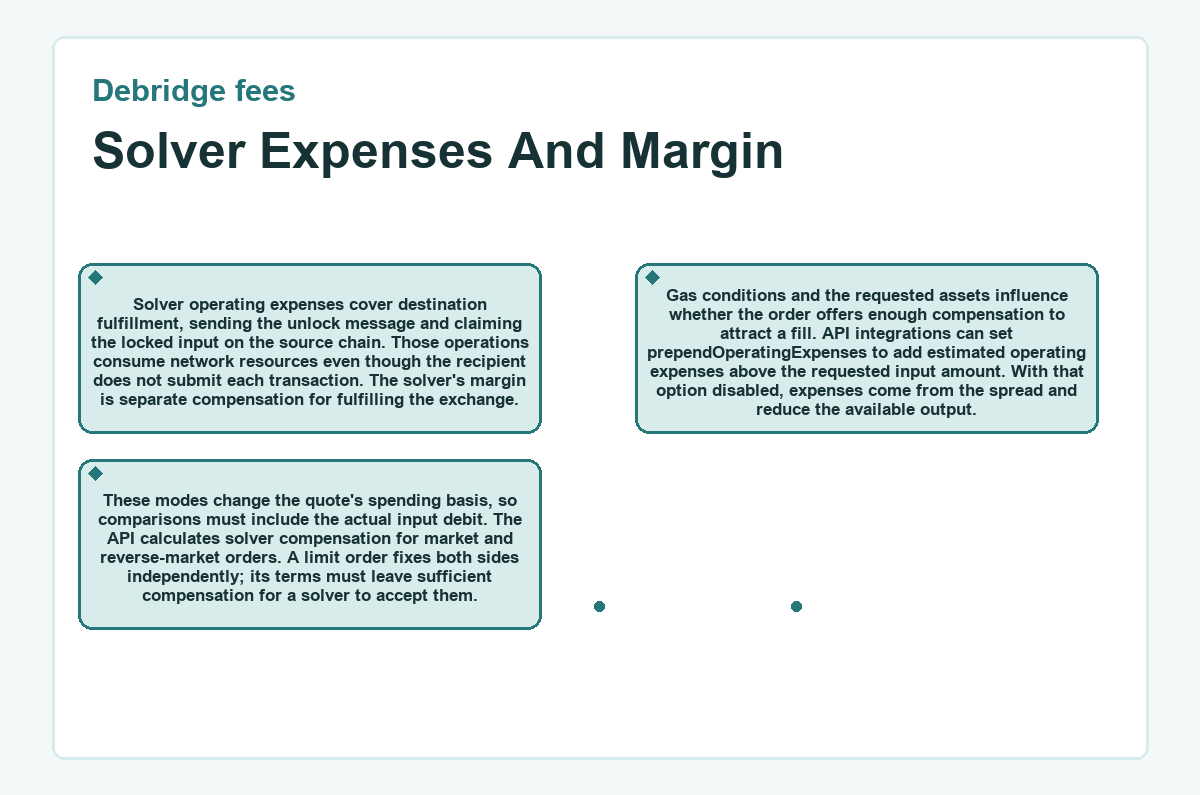
API integrations can set prependOperatingExpenses to add estimated operating expenses above the requested input amount. With that option disabled, expenses come from the spread and reduce the available output. These modes change the quote's spending basis, so comparisons must include the actual input debit. The API calculates solver compensation for market and reverse-market orders. A limit order fixes both sides independently; its terms must leave sufficient compensation for a solver to accept them.
Does Sending More Reduce the Protocol Fee Rate?
A larger DLN order uses the same transfer-fee rate when the source-chain contract settings remain unchanged. Its proportional charge grows with the order input. A fixed native-token charge accounts for a smaller share of a larger transfer's value, provided the valuation basis remains comparable. That changes the effective cost share without changing the configured percentage.
Splitting a transfer into several orders repeats the flat charge for each order.
Larger amounts can also change conversion execution through available liquidity and price impact. A lower share of fixed charges therefore does not establish a lower overall percentage cost. With prependOperatingExpenses disabled, an input can be too small to cover solver operating expenses. In that case, the API may fail to produce a reasonable output estimate for the requested trade.
Token Conversions And Slippage
A route that converts a non-reserve input token into a reserve asset incurs source-swap costs before the DLN order exists. The API accounts for that conversion when preparing the transaction and destination estimate. The destination estimate uses the source swap's minimum output as a conservative basis for the order. That makes the conversion route relevant even when the fee that the DLN contract charges stays unchanged.
A requested destination asset may also require a pre-fill swap from the solver's reserve inventory. The solver then supplies the output amount that the order requires. This conversion contributes to the quote's economics; it does not create a separate manual swap obligation for the receiving wallet. An unavailable conversion route or insufficient liquidity can prevent an executable quote for the chosen assets.
Price impact measures the effect of trade size on the exchange outcome. Slippage describes movement between an estimate and execution. Neither description identifies a payment to the protocol treasury by itself. Keeping conversion effects separate from named fee deductions makes differences between quotes easier to interpret.
Affiliate Charges in Integrated Interfaces
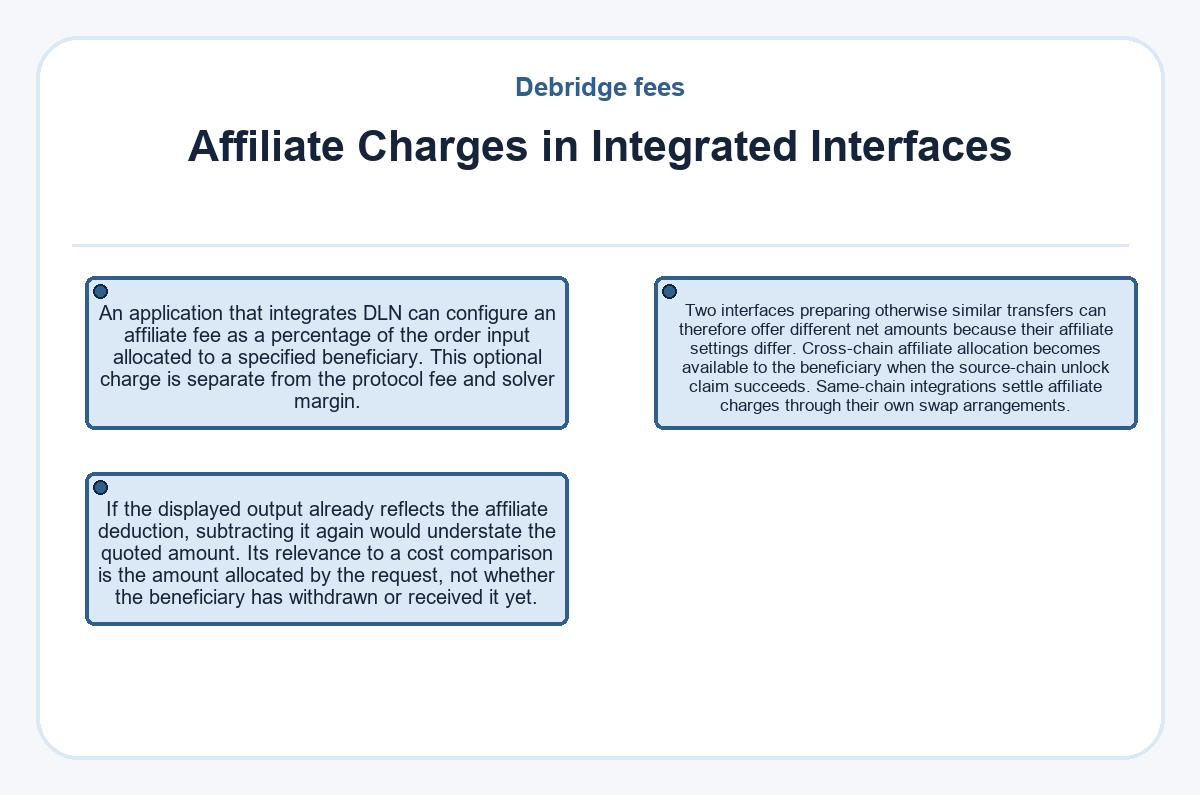
An application that integrates DLN can configure an affiliate fee as a percentage of the order input allocated to a specified beneficiary. This optional charge is separate from the protocol fee and solver margin. Two interfaces preparing otherwise similar transfers can therefore offer different net amounts because their affiliate settings differ.
Cross-chain affiliate allocation becomes available to the beneficiary when the source-chain unlock claim succeeds. Same-chain integrations settle affiliate charges through their own swap arrangements. If the displayed output already reflects the affiliate deduction, subtracting it again would understate the quoted amount. Its relevance to a cost comparison is the amount allocated by the request, not whether the beneficiary has withdrawn or received it yet.
Hooks, Messaging And Subscription Costs
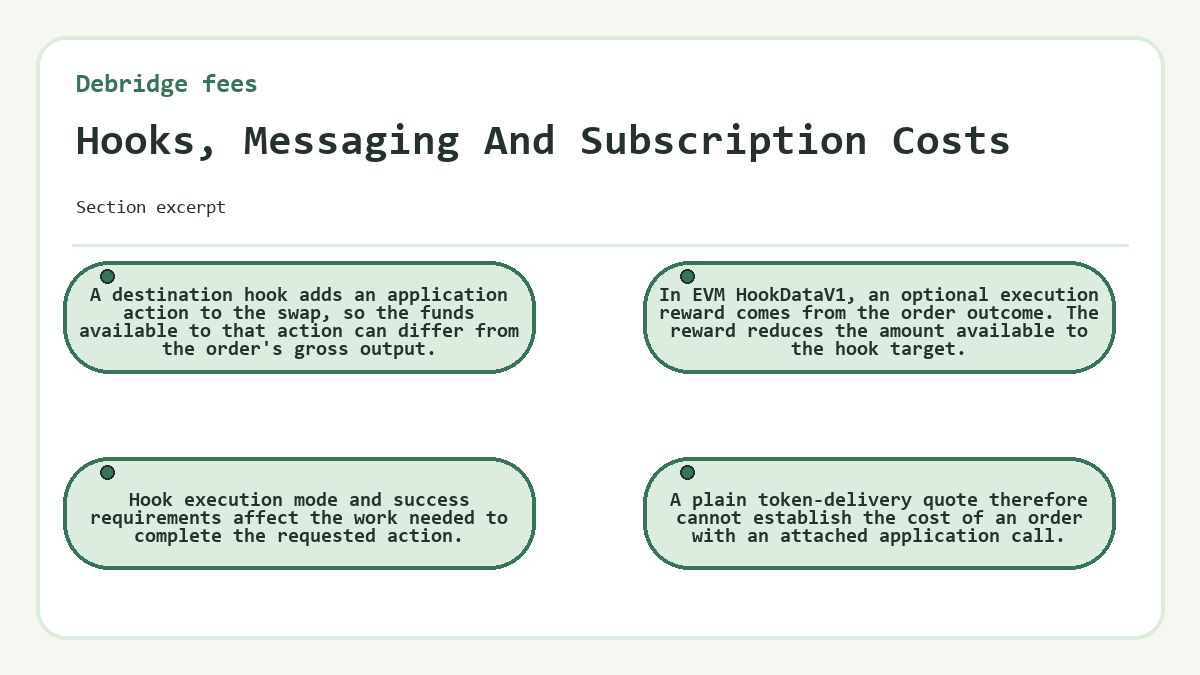
A destination hook adds an application action to the swap, so the funds available to that action can differ from the order's gross output. In EVM HookDataV1, an optional execution reward comes from the order outcome. The reward reduces the amount available to the hook target. Hook execution mode and success requirements affect the work needed to complete the requested action. A plain token-delivery quote therefore cannot establish the cost of an order with an attached application call.
Standalone cross-chain messaging has its own flat charge in the sending chain's native currency. Destination claiming also consumes gas. A submission can include an execution fee to compensate a claimer; automatic delivery depends on that funding covering the claim's execution cost. A gas-price increase can make that incentive insufficient. A manual or programmatic claimer pays destination gas and receives any included execution fee when the claim succeeds.
dePort asset transfers use the messaging infrastructure and a separate asset-transfer fee model. Its standard native-currency payment path combines a fixed charge with a percentage deduction from the transferred asset. The EVM gate can also deduct the fixed component from an ERC-20 transfer when a nonzero token fee is configured for the destination chain. Selecting that option without the required configuration reverts; the native-currency payment path remains an alternative. A DLN swap quote does not describe these dePort charges.
IaaS, or Interoperability-as-a-Service, uses an on-chain subscription to connect a blockchain ecosystem to the infrastructure. That subscription pays for chain connectivity under its own payment schedule. The subscriber's connectivity bill and a wallet's per-order fees belong to different cost comparisons. IaaS requires the first year to be prepaid; later renewals allow monthly, quarterly or annual payments. A payment lapse can stop validation for the connected chain after the applicable grace period.
Can Cancellation Return the Protocol Fees?
A successfully claimed cancellation of an unfulfilled DLN order returns its flat and variable protocol fees. The EVM source contract also returns the affiliate allocation held with the order. Gas spent creating the order or approving tokens on an EVM network does not return with those protocol fees. Cancellation applies to an order that remains eligible for cancellation; it does not reverse a completed destination exchange.
Cancellation requires a destination-chain transaction and a message that releases funds on the source chain. The manual cancellation transaction includes funding for the messaging charge and source-side claim execution, alongside its own network gas. These recovery expenses remain separate from the protocol fees originally held with the order. The destination cancellation authority specified by the order controls the manual request.
A pending cancellation is not a completed refund. If a source swap occurred before order creation, the returned asset is the locked reserve token.
Cost Boundaries Across Execution Options
Different execution options require different cost comparisons, and a paid fee does not establish that the requested exchange or message has completed. Market orders let the API calculate one side of the trade. Limit orders fix both amounts and require a solver willing to accept those terms. Local swaps and standalone messages have different execution boundaries.
| Execution Option | Cost And Execution Boundary |
|---|---|
| DLN market order | The API calculates output with solver compensation; fulfillment still requires a solver that accepts the order. |
| DLN limit order | Fixed input and output must leave adequate solver compensation; protocol fee payment does not guarantee fulfillment. |
| Same-chain swap | Compare local swap costs, wallet gas and any affiliate deduction; execution stays on one network. |
| Standalone message | Compare the messaging flat fee and claim-execution funding; delivery requires a successful destination claim. |
Comparable Quotes And Final Cost Records
A meaningful cost comparison holds the source asset, destination asset and intended outcome constant. For a fixed input, the comparable output uses the same total spending allowance, including any expenses added above the input. For a fixed destination requirement, a reverse-market quote calculates the required source amount. Its wallet gas and native-token charges still belong in the total funding requirement.
Fees denominated in different assets need a common valuation basis before their values can be added. Raw token quantities alone do not provide that basis. Fresh quotes also matter because market prices, available liquidity and network conditions can change while the transaction remains unsigned. The exchange terms accepted on-chain and the resulting transfer records describe the completed trade more precisely than an earlier displayed estimate.
A bridge followed by a destination swap must account for the bridge charge, conversion outcome and gas for the additional action. A combined cross-chain swap incorporates its solver and conversion costs into its own quote. Both alternatives need the same destination asset and spending basis. A lower bridge charge can coincide with a worse destination swap rate, so the full route can deliver fewer tokens despite the smaller advertised fee.
Things people ask about Debridge fees
Why Can an Approval Amount Exceed the Transfer Amount?
An approval amount can include solver operating expenses added above the transfer input. When prependOperatingExpenses is enabled, the API returns an input amount that includes that extra funding. An allowance capped at the originally entered amount may therefore be insufficient. The allowance authorizes a spending ceiling; its size alone does not establish the amount that the executed transaction actually takes.
What Happens to Gas If Order Creation Reverts?
An EVM order-creation transaction that executes and reverts still consumes network gas. The revert undoes that transaction's order creation and asset transfers, so it does not leave a successfully created DLN order to cancel. A previously completed token approval remains a separate transaction with its own gas cost. A wallet rejection before submission is a different event and does not execute the proposed transaction.
Does a Referral Code Automatically Add an Affiliate Charge?
A referral code alone does not establish an additional affiliate deduction. Referral tracking and affiliate pricing use distinct request parameters. An affiliate charge requires its amount and beneficiary settings, while a code can identify activity without proving that charge exists. The transfer's quoted amounts and configured affiliate allocation determine its cost; referral labels or potential rewards do not substitute for those amounts.
Can a Higher Slippage Tolerance Reduce the Transfer Fee?
Changing slippage tolerance does not change the DLN contract's configured transfer-fee rate. It affects the permitted outcome of an applicable token conversion, which can alter execution or the resulting amounts. A percentage fee can produce a different token deduction if its calculation basis changes, even while its rate stays constant. Accepting a wider conversion range is therefore a different decision from obtaining a protocol fee discount.
Why Can a Solana Cost Estimate Exceed the Network Transaction Fee?
A Solana cost estimate can include account funding and the DLN fixed fee alongside network and priority fees. The API's source-transaction breakdown combines these categories, so its total is broader than the network transaction fee alone. Account creation depends on the accounts that the transfer needs and whether they already exist. Adding a separately displayed fixed fee again can double-count that charge.
Are the API's Dollar Estimates My Exact Transfer Cost?
The API's approximate dollar values are informational estimates, not an exact executable fiat charge. Order delivery follows specified token amounts, while protocol fees and network expenses retain their respective asset units. A difference between estimated input and output dollar values can reflect exchange pricing as well as fees. Those estimates should not become an extra fee deduction in a calculation that already accounts for the same costs.
Updated