Debridge connects blockchains with solver liquidity and authenticated messaging
Debridge connects blockchains through liquidity supplied by solvers and a messaging network. Its Debridge Liquidity Network (DLN) matches cross-chain orders with solvers that provide destination tokens from destination-chain balances. The messaging layer carries the instructions that settle those orders. A separate product, dePort, creates collateral-backed token representations across supported networks. The platform also provides same-chain swaps, programmable destination actions and application integration tools. These capabilities address different tasks: obtaining an existing destination asset, extending a token to another chain or communicating between contracts. Their liquidity requirements and completion conditions differ, even when an interface combines several actions.
In a standard DLN transfer, destination token delivery precedes the message that releases the solver's source-chain payment.
A DLN Order From Quote to Receipt
For a DLN transfer without a hook, the prepared order must identify its destination network, token, recipient and amount. Reviewing or refreshing a quote does not commit funds. In the standard transaction-based path, successful on-chain order creation commits the input asset to a smart contract; a token approval alone does not create an order.
The sending wallet needs its input balance, source-chain gas, the flat protocol fee and any required token allowance. Control of the destination order authority matters before submission because that address governs cancellation.
- Before committing, confirm the destination token address or native-asset identifier, receiving address and accepted output amount in the prepared order.
- On normal completion, inspect the destination fulfillment transaction and the transfer to the configured recipient.
- If delivery remains pending, inspect the existing order status before submitting another trade that would commit additional funds.
- Choose cancellation for an eligible unfulfilled order only with control of the destination authority and funds for gas and messaging costs.
- Confirm recovery through the source-chain refund to the configured beneficiary; a cancellation request alone does not establish receipt.
Liquidity Exchange and dePort Asset Representations
DLN Cross-Chain Swaps
DLN trades require sufficient liquidity to obtain the requested destination asset and compensate a solver, and their output can differ from the input token. For a non-reserve input token, the API includes a source-side swap into a reserve asset before creating the order. Destination-side routing can obtain the requested output from a reserve asset. These conversions depend on available trading liquidity and their execution limits. A token's presence on a supported network does not establish that every requested pair has a viable route.
Same-Chain Swaps
Same-chain swaps exchange tokens within one network and do not require cross-chain settlement. The API evaluates aggregator routes, simulates execution and prepares a transaction for the connected wallet. Slippage controls and quote freshness remain relevant because market prices can change before submission. This path suits token conversion when the destination network already holds the funds.
dePort Collateral and deAssets
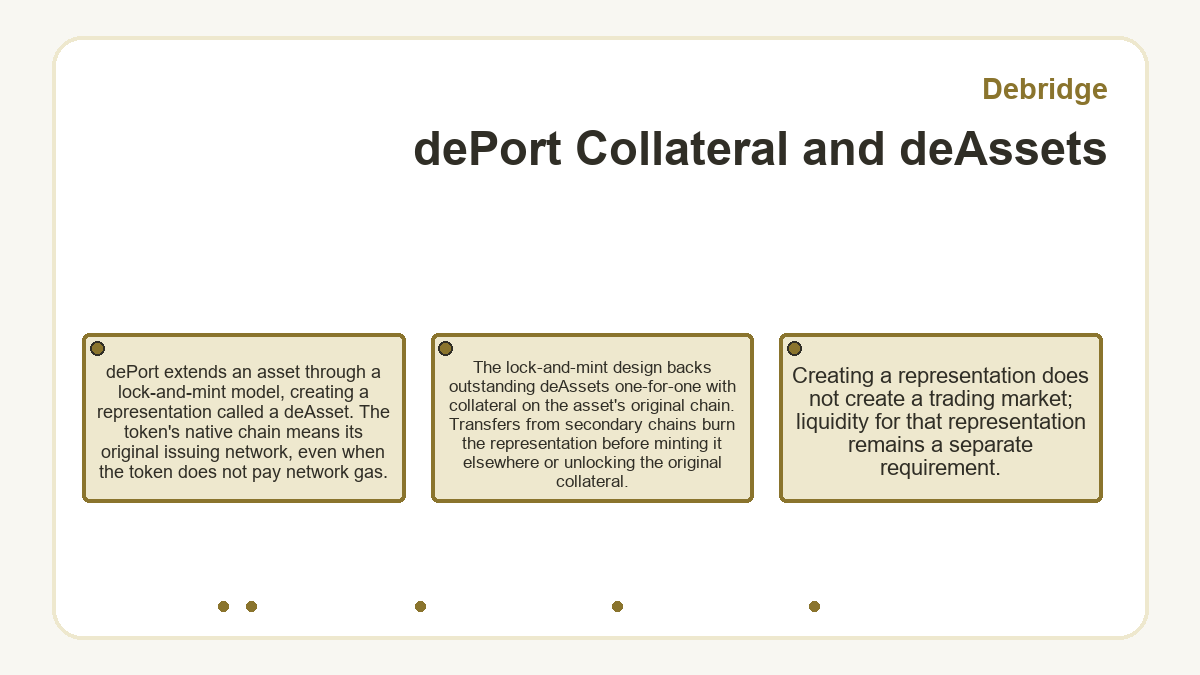
dePort extends an asset through a lock-and-mint model, creating a representation called a deAsset. The token's native chain means its original issuing network, even when the token does not pay network gas. The lock-and-mint design backs outstanding deAssets one-for-one with collateral on the asset's original chain. Transfers from secondary chains burn the representation before minting it elsewhere or unlocking the original collateral. Creating a representation does not create a trading market; liquidity for that representation remains a separate requirement.
Solver Fulfillment and Source-Chain Settlement
Destination Token Delivery
A solver fulfills an order by supplying its requested tokens through the destination contract, DlnDestination. The contract checks the order identifier and its status before processing fulfillment, which delivers the specified output amount to the recipient in an ordinary transfer without a hook. The source-chain payment remains separate from this destination delivery. Eligible solvers compete for orders and choose when to act based on profitability and source-chain confirmation risk.
The 0-TVL design avoids shared DLN liquidity pools. Individual orders still hold assets temporarily in source-chain escrow.
Messaging and Solver Payment
The successful solver initiates a settlement message after destination fulfillment, authorizing DlnSource, the source-chain contract, to release the order's escrow to the solver. Messaging validation has its own finality requirements, so destination delivery can precede the solver's receipt of payment. A source transaction hash alone does not prove destination receipt.
Authenticated Messages and Programmable Calls
Validator Authentication
The Debridge Messaging Protocol (DMP) transports arbitrary data and instructions between supported blockchains. Validators monitor source events and sign submissions after the required transaction confirmations. The messaging contracts accept a submission only after verifying the required threshold of validator signatures. A keeper or another submitting address can present those signatures to execute the destination claim. This infrastructure supports contract interactions beyond token exchange, including messages that coordinate application state across networks.
The messaging layer relies on validator consensus and correct contract execution. Its authentication does not establish that an application's business logic is correct.
Destination Hooks
DLN hooks attach destination actions to orders, including deposits into compatible contracts. On EVM networks, atomic hooks execute within fulfillment, while non-atomic hooks may execute later. A success-required hook failure reverts its execution transaction, including fulfillment if they run together. An optional-success hook failure sends output to the configured fallback. Solana supports non-atomic, success-required hooks. The selected configuration determines whether token fulfillment and the attached action complete together.
Sender Identity and Contract Permissions
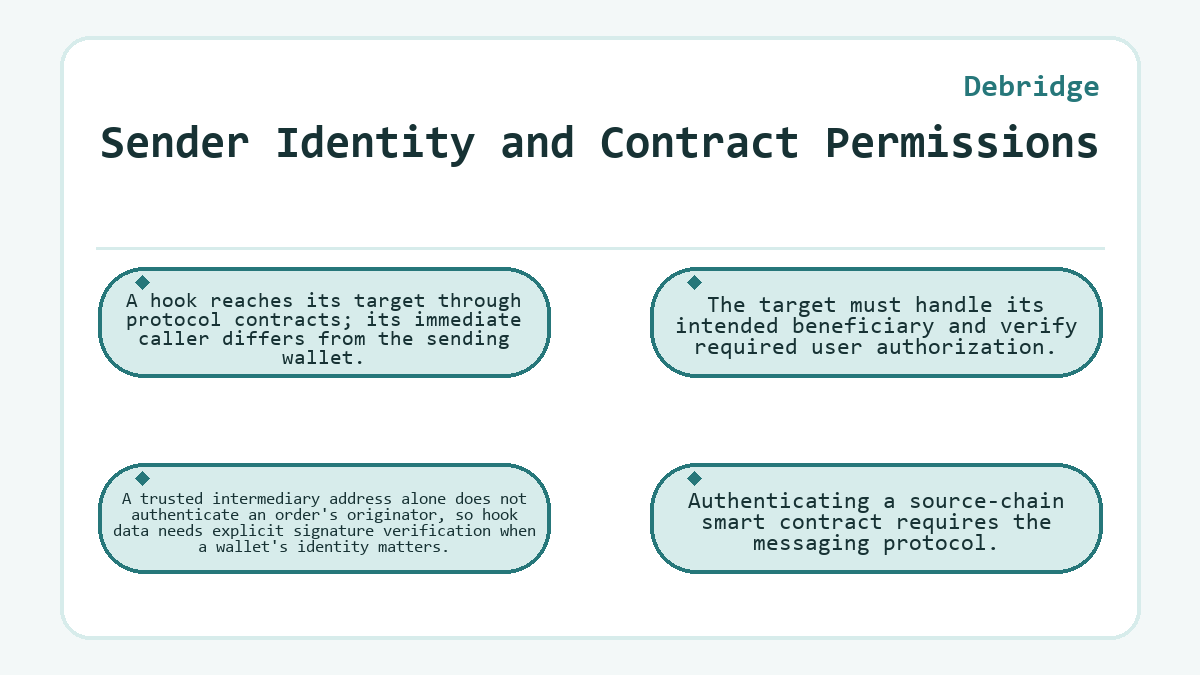
A hook reaches its target through protocol contracts; its immediate caller differs from the sending wallet. The target must handle its intended beneficiary and verify required user authorization. A trusted intermediary address alone does not authenticate an order's originator, so hook data needs explicit signature verification when a wallet's identity matters. Authenticating a source-chain smart contract requires the messaging protocol.
Interfaces, Integrations and Chain Onboarding
The main application provides an entry point for selecting swaps and cross-chain transfers. Debridge P2P supports cross-chain over-the-counter orders with a chosen counterparty. Applications can embed a customizable widget or use the DLN API to construct their own interface. An integration can also attach hooks when its destination contracts support the intended action. Quotes account for protocol charges, solver incentives and operating costs; integrations can add affiliate fees. Source-chain transaction gas also affects the total spend, so a quote comparison needs the prepared order's output alongside its disclosed input and charges.
IaaS, or Interoperability-as-a-Service, connects blockchain ecosystems to messaging, DLN liquidity exchange and dePort custody infrastructure. It targets Ethereum Virtual Machine (EVM) and Solana Virtual Machine (SVM) ecosystems through an on-chain subscription. Infrastructure support differs from inclusion in the main application: a connected chain can remain accessible through an integrated widget or API even when the main application's listing criteria exclude it. Connectivity also depends on the chain's operation and subscription status; integration does not establish the chain's security.
Bundles extend the platform toward coordinated interactions across chains through a shared execution framework. Their documented availability is restricted to selected integrators in a private rollout.
Unfulfilled Orders and Limited Recovery
An unfulfilled DLN order can remain open when solvers find its terms unprofitable or its risks unacceptable. Limit orders deliberately specify terms that may need different market conditions before execution. A fixed output requirement governs acceptable fulfillment; it does not guarantee that a solver will fulfill the order.
Cancellation applies while the order remains eligible, before fulfillment. For manual cancellation, the designated destination-chain authority initiates the request, and messaging carries the refund instruction to the source contract. Approved integrations can enable automatic cancellation for unfulfilled market orders linked to a referral code. This setup gives cancellation authority to a Debridge-controlled address and subsidizes cancellation costs; the source-chain refund beneficiary must remain user controlled. Limit orders are excluded from automatic cancellation. That authority and the source-chain refund beneficiary have separate roles, and cancellation finalizes only when the source-chain assets reach the configured beneficiary.
Cancellation returns the asset held in escrow, which is a reserve asset if order creation first converted the original input. It does not undo the earlier swap. A replacement trade therefore needs to reflect the balance actually returned.
The protocol returns the fees that it held with a cancelled order, including applicable affiliate fees. Already spent network gas remains a transaction cost. Manual cancellation also needs destination-chain gas and payment for messaging and source-chain claim execution.
A fulfilled order can still have a non-atomic hook awaiting execution. The destination authority can cancel that pending hook under its applicable rules and receive the destination output. Hook cancellation releases that output; it does not reverse the fulfilled trade or refund its source-chain input.
Helpful answers about Debridge
Do I Need a Destination Gas Balance to Receive a DLN Transfer?
An ordinary DLN transfer does not require the recipient to pay destination gas just to receive its tokens. The solver submits destination fulfillment. Later spending, a separate contract interaction or a manually initiated cancellation can require native gas on that network.
Can the Receiving Wallet Differ From the Wallet That Sends the Order?
A DLN order can specify a destination recipient independently of its sending wallet. The recipient must match the destination network's address requirements. Receiving tokens and controlling cancellation are separate roles, so the order's destination authority and source-chain refund beneficiary also need appropriate configuration.
Why Does a DLN API Chain ID Sometimes Differ From the Wallet Network ID?
Some supported networks use internal identifiers in the DLN API that differ from their standard network identifiers. Integration requests must use the API's mapping for the selected network. Wallet configuration follows its own network identifier; copying it blindly into a DLN request can select an incorrect or unsupported value.
What Transfer Information Is Visible in deExplorer?
deExplorer displays public order records and their statuses, with searches by order ID, transaction hash or wallet address. Its records provide cross-chain transaction and fulfillment details. A wallet address can therefore connect activity across the transfer's source and destination networks; the explorer does not make those transactions private.
Are API Keys Required to Experiment With DLN?
Public DLN API access allows unauthenticated requests within its rate limits. Commercial integrations require dedicated API keys, and authenticated access supports higher request limits. An API key controls access to the service; it does not authorize wallet transactions or grant permission to spend the wallet's tokens.
Does Every DLN Trade Settle in DBR?
No. DBR is the ecosystem's governance token. Standard DLN orders use their specified trading assets. The flat protocol fee and network gas use source-chain native currency; the variable protocol fee comes from the input asset. Holding DBR is not a general prerequisite for a transfer.
Updated